The short answer
Nobody can say for sure, and the sources disagree. The standard reference, New Georgia Encyclopedia, says the town “was said to be named for” Col. William Cumming, a Georgia native who made his reputation as a U.S. Army colonel in the War of 1812. A local historian, Frank Clark of the Bell Research Center, told Forsyth County News in 2019 that he thinks the name honors a different man with the same surname: the Rev. Frederick Cumming, a teacher at an academy in Wilkes County. The City’s own Our Community page gives the charter dates but does not say who the city is named for.
Notice the hedge in the encyclopedia’s wording. “Was said to be” reports a tradition. It does not point to a document. That gap is where the argument lives.
What is the case for Col. William Cumming?
It is the older and more official answer. In 1962 a state historical marker titled “Colonel William Cumming” went up at the Forsyth County courthouse. Its text, as the Georgia Historical Society records it, opens: “The town of Cumming (incorporated 1834) is named in honor of Col. William Cumming, distinguished Georgian.” There is no “said to be” on the marker. It states the link as fact.
The marker then gives his record. He was born in 1788, graduated from the College of New Jersey (Princeton) and studied law in Litchfield, Connecticut. In the War of 1812 he led the Augusta Independent Blues, was commissioned a major in 1813 and became adjutant general of the Northern Army, with the rank of colonel, in 1814. He resigned in 1815, turned down later appointments as quartermaster general (1818) and major general (1847), and died in Augusta on Feb. 18, 1863. His duels in 1822 with George McDuffie of South Carolina, the marker says, “received nationwide attention.”
New Georgia Encyclopedia repeats the attribution, with its hedge. Neither the marker nor the encyclopedia entry, as published online, explains why a new town in former Cherokee country would honor an Augusta officer, or cites a record from 1833 or 1834 that names him.
What is the case for the Rev. Frederick Cumming?
Clark, a founder and curator of the Bell Research Center, made his argument at a talk on local road and place names that Forsyth County News covered in January 2019. He called the popular explanations “total nonsense.” On Col. Cumming, he said the officer was Augusta-based and that the name was tied to him after the fact.
His alternative runs through Jacob Scudder, whom he called “the first prominent citizen” of the area. Scudder, a Wilkes County native, received land in north Forsyth in the 1832 Georgia Land Lottery and bought land in what is now downtown Cumming from a former schoolmate. The two had been students at an academy in Wilkes County, Clark said, and their teacher was the Rev. Frederick Cumming.
“I think two and two equals four.” Frank Clark, Bell Research Center, quoted by Forsyth County News, 2019
That is an inference, and Clark framed it as one. The article does not name the schoolmate, and it does not cite a document in which either man names the town for his old teacher.
The same article mentions a third name that sometimes comes up, Sir Alexander Cumming, an Englishman who, the paper says, arranged for American Indians to meet royalty. Clark called him an unlikely candidate.
What evidence would settle it?
Not the spelling. Both leading candidates were named Cumming, so the name on the city limits sign fits either man. What would settle it is a record made when the town was named, in 1833 or 1834, that says who it was named for.
The obvious places to look are the December 1834 act of the legislature that incorporated the town, the records of the local officials who bought the town land in 1833 and 1834, the paperwork for the post office opened in January 1834, and any letters left by Scudder or his schoolmate. We have not seen the text of any of these, and neither source discussed here quotes one.
A record from those years naming the colonel would back the marker. One naming the minister, or showing that the colonel’s name was attached only later, would back Clark. Until something like that turns up, the honest answer is that the question is open. A marker records what people believed in 1962. It is not, by itself, evidence from 1834.
What is certain about the founding?
Much more than the name. These dates are not in dispute:
- 1832: Georgia created Forsyth County, one of 10 counties carved from former Cherokee lands. It is named for John Forsyth, governor of Georgia from 1827 to 1829 (New Georgia Encyclopedia: Forsyth County).
- 1833: Cumming was founded, a year after the county was created.
- 1833 and 1834: Local officials bought the town land, two forty-acre lots from the 1832 Cherokee land lottery. They divided it into smaller lots, sold them off over several years and reserved one lot for the county courthouse.
- January 1834: The post office was established.
- December 1834: The legislature incorporated Cumming and made it the county seat. The City dates its first state charter to 1834.
- 1845: A second charter made Cumming a mayor-and-council form of government (City of Cumming).
So the town was planned around a courthouse from the start: one lot was held back for it before most of the others were sold. The land itself had been Cherokee land before the 1832 lottery handed it out. The fuller story of the county, including its hardest chapters, is on our Cumming history page.
Where can you see this downtown?
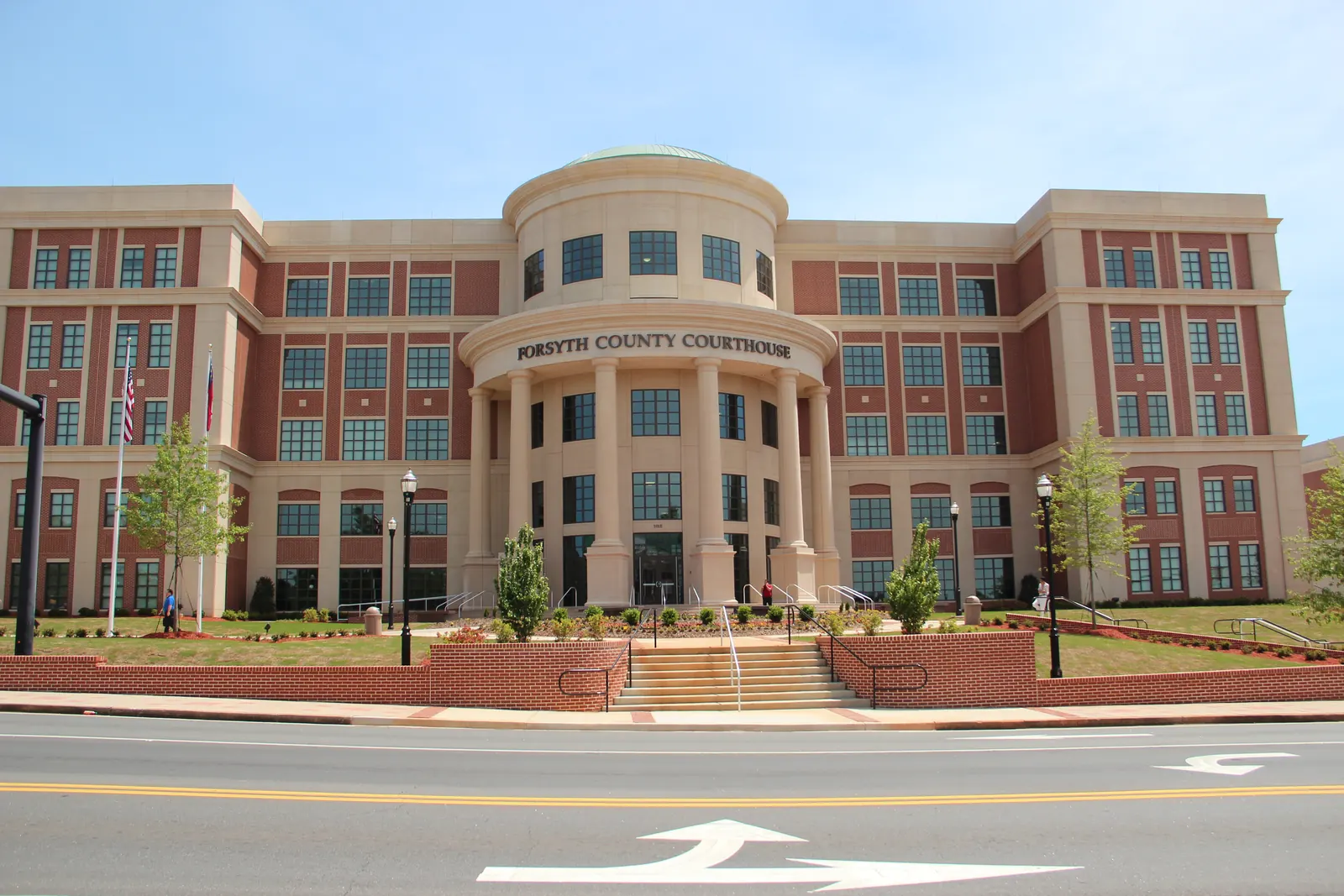
Start at the courthouse. The Georgia Historical Society lists the “Colonel William Cumming” marker as standing on Veterans Memorial Boulevard at the Forsyth County courthouse. The courthouse there today, at 101 E. Courthouse Square where Main Street meets Veterans Memorial Boulevard, opened on March 16, 2015. The marker went up in 1962, long before that building. We have not confirmed its exact spot after the rebuild, so look for it rather than count on it.
If you find it, read it with the encyclopedia’s hedge and Clark’s challenge in mind. Then walk the rest of the square, from the 1915 bandstand to City Hall, with our historic downtown guide. Parking and timing for the visit are on plan your visit.
Questions about Cumming’s history
How did Cumming get its name?
Nobody knows for sure. New Georgia Encyclopedia says the town "was said to be named for" Col. William Cumming, a Georgia native who made his name as a U.S. Army colonel in the War of 1812. Local historian Frank Clark of the Bell Research Center disagrees. In 2019 he told Forsyth County News he believes the name honors the Rev. Frederick Cumming, who taught early settler Jacob Scudder at a Wilkes County academy.
Source: New Georgia Encyclopedia: Cumming; Forsyth County News, Jan. 24, 2019
How old is Cumming?
New Georgia Encyclopedia says Cumming was founded in 1833, a year after Georgia created Forsyth County from former Cherokee land. The City says the state first chartered Cumming in 1834, and a second charter in 1845 set up its mayor-and-council government. Forsyth County is named for John Forsyth, Georgia's governor from 1827 to 1829.
Source: City of Cumming: Our Community; New Georgia Encyclopedia: Cumming, Forsyth County
How big is the Cumming fair?
The City calls it the largest single event in Forsyth County. The sources disagree on attendance: the City's Our Community page says the 11-day fair typically draws 175,000 to 210,000 people, while the Fairgrounds site says it attracts more than 250,000. The first fair, in October 1995, was a five-day event at the then-new Fairgrounds.
What is the Steam Engine Parade?
The Thomas-Mashburn Steam Engine Parade is Cumming's July 4 tradition. Antique steam engines, tractors, vintage cars and floats roll south on Tribble Gap Road from Forsyth Central High School to the Cumming Fairgrounds. In 2026 it started at 10 AM, and the Fairgrounds celebration ran 4–10 PM with fireworks around 9:30. The Antique Steam Engine Association organizes the parade. The 2027 schedule isn't out yet.
Source: Cumming Fairgrounds events calendar; City of Cumming parade page
What can I see on the historic courthouse square?
The current Forsyth County Courthouse opened in 2015. The square also has Cumming City Hall (2002), with a Hiram Parks Bell statue on its lawn, and the 1915 Cumming Bandstand, listed on the National Register in 2002. Nearby are the restored Sinclair gas station, now Cumming Cigar Co. at 203 E. Main St., and a 2021 historical marker for Rob Edwards at East Courthouse Square and West Maple Street.
Source: City of Cumming: City Hall, Our Community; NPS NPGallery; Equal Justice Initiative; Appen Media
What happened in Forsyth County in 1912?
In September 1912, after a young white woman, Mae Crow, was killed, a white mob lynched Rob Edwards, a Black man, in downtown Cumming. Two Black teenagers were hanged after one-day trials. Night riders then drove the county's Black residents out: about 1,100 lived there in 1910 and only 17 in 1930. A downtown marker placed in 2021 remembers Edwards.
Source: New Georgia Encyclopedia: Forsyth County; Equal Justice Initiative
Written by the Downtown Cumming Editorial Team. AI tools help us draft; people check every fact before it publishes.
Dates, rules and hours can change. The organisers have the final word: City of Cumming